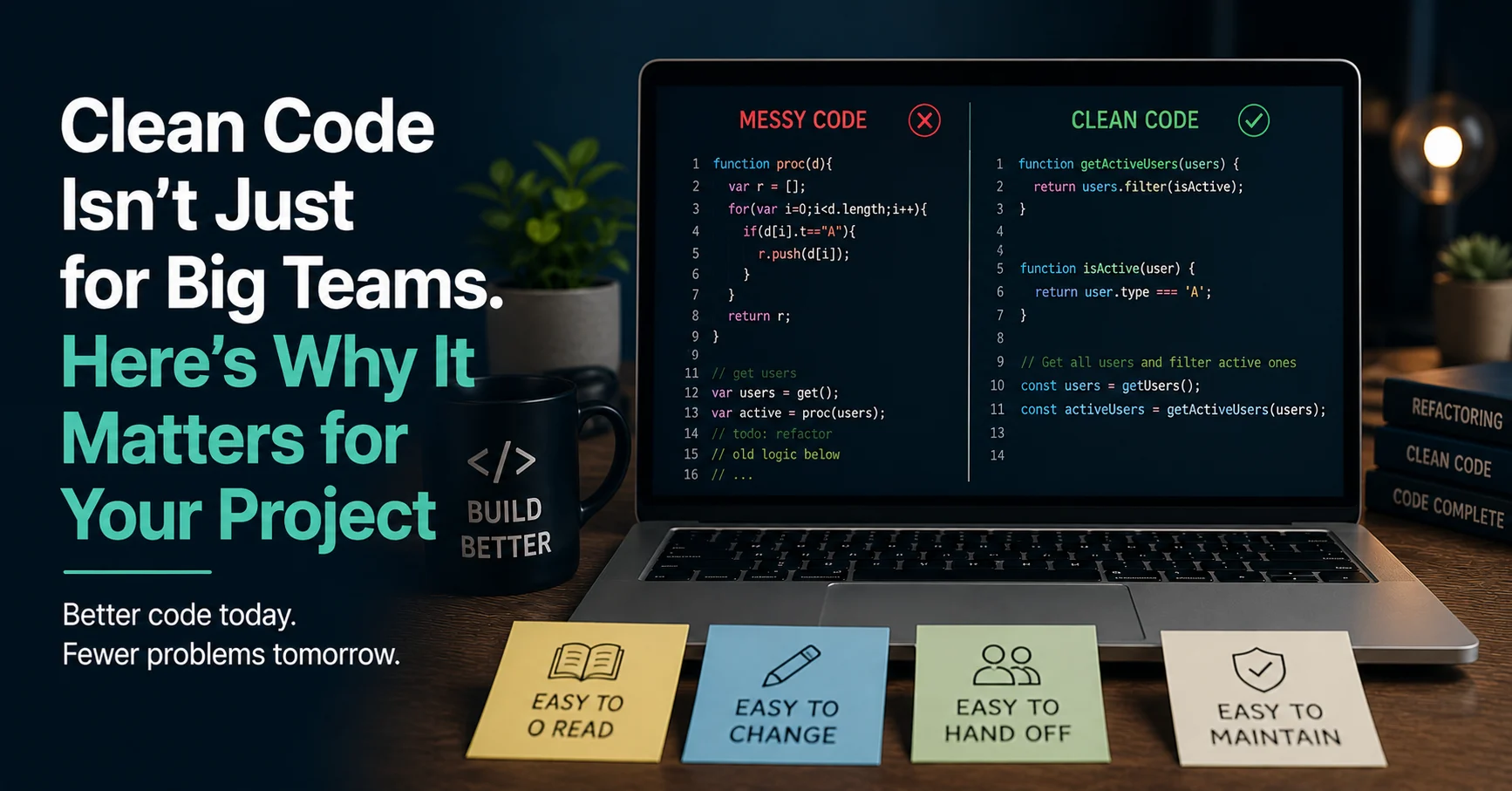
There is a common assumption that clean code is something large engineering teams worry about. Something that matters when you have ten developers working on the same codebase, but not when you are hiring one person to build a website or a small application.
That assumption is wrong, and it tends to be expensive to discover.
What clean code actually means
Clean code is not about following a rigid set of rules or writing code that looks impressive. It is about writing code that is easy to read, easy to change, and easy to hand off to someone else.
It means using names for variables and functions that describe what they do. It means keeping functions short and focused on one thing. It means not leaving behind commented-out blocks of old code, unused files, or logic that only makes sense if you were there when it was written.
It is the difference between a codebase that a new developer can understand in an afternoon and one that takes weeks to make sense of, and even then only partially.
Why it matters for smaller projects
Small projects do not stay small forever. A website that starts as five pages often becomes fifteen. A plugin built for one specific purpose gets extended to do three more things. A client comes back a year later needing changes, and whoever opens the code at that point needs to be able to understand it quickly.
If the original code was written without care, every change becomes harder and riskier than it should be. Developers charge more to work on messy codebases because they cost more time. Bugs are harder to find. New features take longer to build because everything is tangled together.
Clean code from the start means every future change is cheaper and faster.
What it looks like in practice
When I deliver a project, the code is structured so that someone else could pick it up without needing me to explain it. File names make sense. Functions do what their names say they do. There are no surprises hiding in the logic.
I also avoid over-engineering. Clean code does not mean complex code. It means the simplest solution that solves the problem correctly and can be maintained without pain. Adding unnecessary layers of abstraction is just a different kind of mess.
The long-term cost of cutting corners
Technical debt is real. It accumulates quietly and then becomes suddenly very expensive when a project needs to grow or change. I have seen small sites that cost three times more to update than they should because the original developer prioritised speed over quality.
The clients who suffer most from this are the ones who did not know to ask about code quality when they hired someone. It is not an obvious thing to check unless you know what to look for.
What to ask before hiring a developer
You do not need to read code to care about its quality. A few questions tell you a lot. Ask if they follow any coding standards. Ask how they structure their projects. Ask what happens if you need to hire someone else to continue the work after them.
A developer who thinks about these things will have clear answers. One who does not will either get defensive or give vague reassurances.
If you want to work with someone who takes this seriously, get in touch. Code quality is not an optional extra for me. It is part of how I work on every project, regardless of size.