This is one of the most common questions I get from clients who are starting a new project. Should they go with WordPress or build something custom? The answer is not one-size-fits-all, but there is a clear logic to it once you understand what each option actually means.
What WordPress is good at
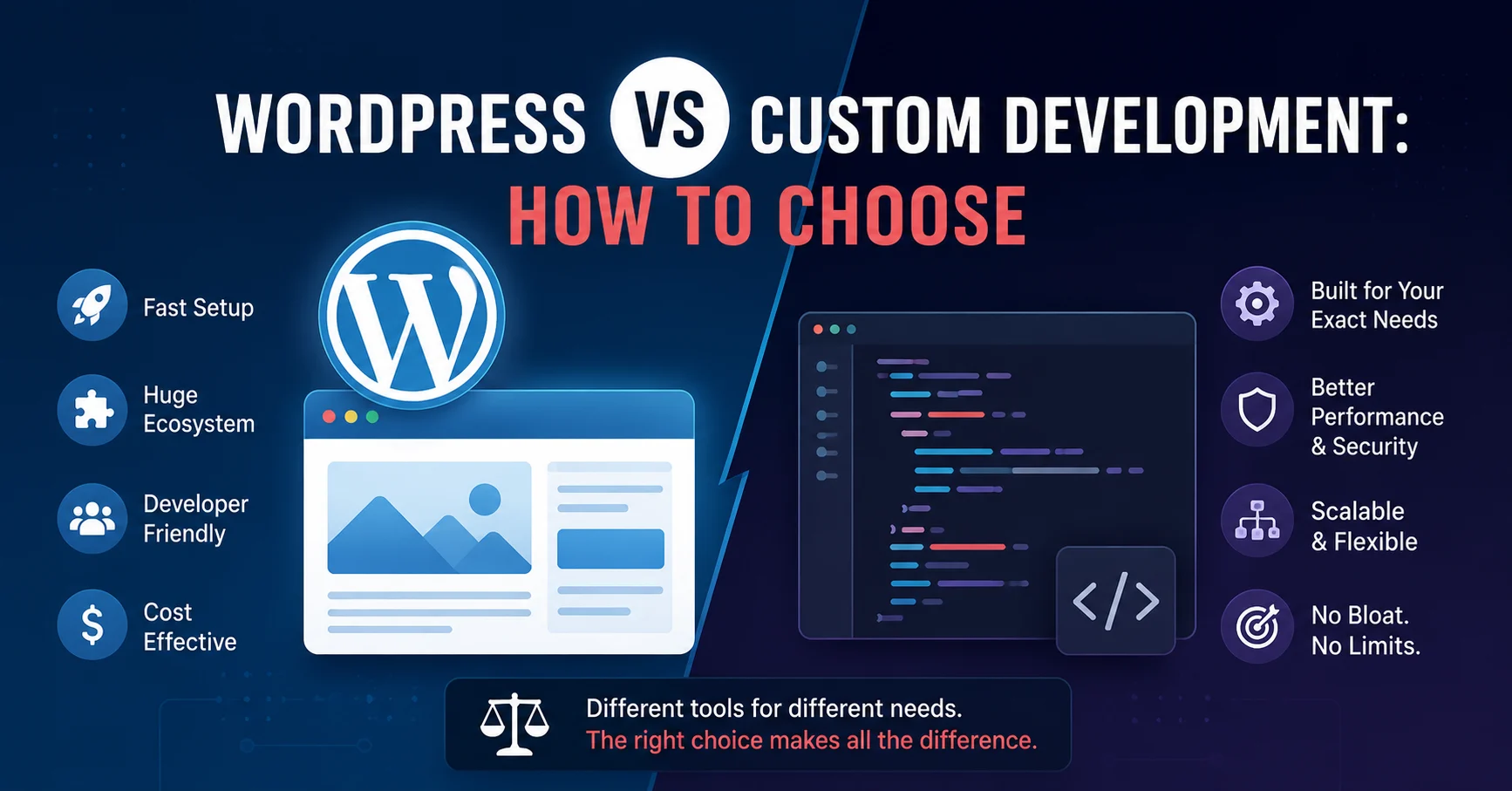
WordPress powers around 40% of the web for a reason. It is fast to set up, has a massive ecosystem of themes and plugins, and most developers know how to work with it. For a business that needs a professional website, a blog, or a content-heavy platform, WordPress is hard to beat on cost and speed.
If your requirements are covered by what already exists in the ecosystem, there is no good reason to build from scratch. You would be paying for something you could have for a fraction of the price.
WordPress works well when you need a marketing site, a portfolio, a small e-commerce store, a blog, or a content platform with standard functionality. It also works well when you need to launch fast and iterate later.
Where WordPress falls short
WordPress starts to show its limits when your requirements go beyond what plugins and themes can handle cleanly. When you need complex custom logic, deep integrations with other systems, very specific user flows, or performance at scale, bending WordPress to fit those needs often creates more problems than it solves.
The other issue is technical debt. A heavily customised WordPress site built by multiple developers over time can become fragile and expensive to maintain. Each plugin update is a potential conflict. Each new requirement means another workaround on top of existing workarounds.
What custom development gives you
A custom-built application is designed around your exact requirements. There is no bloat, no unnecessary dependencies, and no plugin conflicts. The codebase does exactly what it needs to do and nothing more.
Custom development makes sense when your product is the software itself, when you have complex workflows that do not fit a standard CMS, when you need tight control over performance and security, or when you are building something that will scale significantly over time.
The tradeoff is cost and time. Custom development takes longer and costs more upfront. But for the right project, it is the only option that holds up long term.
The question to ask yourself
The best way to decide is to be honest about your requirements. If a standard website with some customisation covers 90% of what you need, WordPress is probably the right call. If your requirements are fundamentally different from what WordPress was built to handle, custom development will save you money and headaches in the long run.
I have built both, and the projects that go wrong are almost always the ones where the wrong tool was chosen at the start. A WordPress site that should have been custom, or a custom build that did not need to be.
If you are not sure which direction makes sense for your project, get in touch. That is exactly the kind of conversation I have with clients before any work begins.