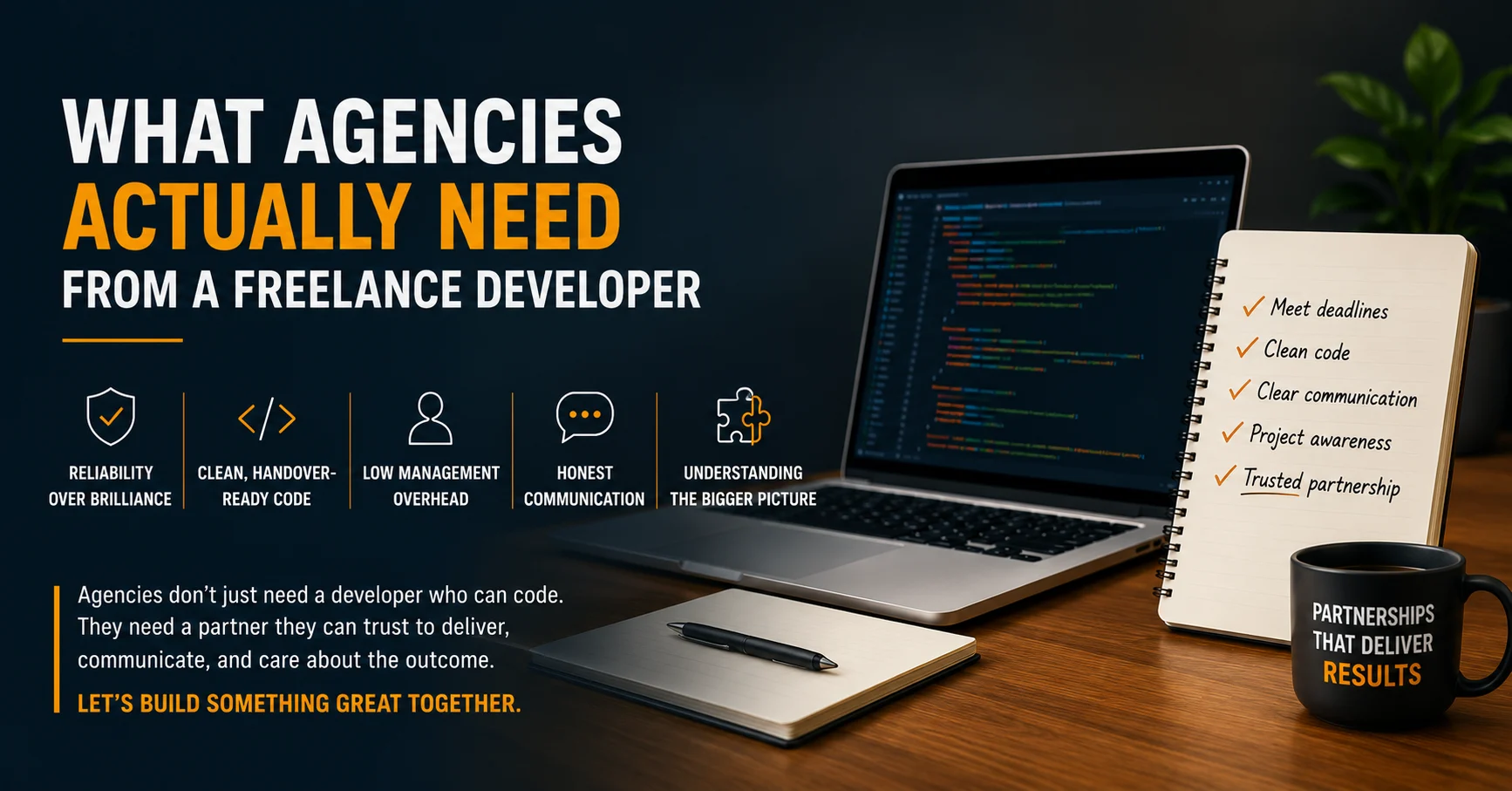
Most agencies have been burned by a freelancer at least once. A developer who disappeared mid-project, delivered spaghetti code nobody could maintain, or needed so much hand-holding that it created more work than it saved. After enough of those experiences, hiring freelancers starts to feel like a gamble.
I work with agencies regularly, and over time I have learned that what they actually need goes well beyond technical skills. Here is what makes the difference between a freelancer an agency calls once and one they keep coming back to.
Reliability over brilliance
Agencies are managing clients, deadlines and multiple moving parts at the same time. What they need from a freelancer is not someone who occasionally delivers something brilliant, but someone who consistently delivers what was agreed, when it was agreed. A developer who is a 7 out of 10 technically but a 10 out of 10 on reliability is worth far more than a genius who goes quiet for days.
If you say something will be ready on Thursday, it is ready on Thursday. If something comes up, you communicate early and not after the deadline has passed.
Clean, handover-ready code
Agencies often bring in freelancers for specific tasks, then hand the work back to their internal team or another developer. If the code you deliver is only understandable to you, you have created a problem for everyone downstream.
Good code means consistent naming conventions, no unnecessary complexity, proper comments where the logic is not obvious, and a structure that another developer can pick up without needing a guided tour. It is not about showing off. It is about being professional.
Low management overhead
The agency is not your project manager. When you take on a task, you should be able to run with it independently, ask the right questions upfront, and get it done without needing daily check-ins or constant clarification.
Agencies that work well with freelancers are the ones who can hand off a brief and trust it will come back done. If every small decision requires a back-and-forth, you are adding friction to their workflow instead of removing it.
Honest communication
If a requirement is unclear, ask before you build the wrong thing. If a deadline is not realistic, say so before you miss it. If you spot a problem in the brief that will cause issues later, flag it.
Agencies value a freelancer who speaks up when something is off. What they cannot afford is someone who stays quiet, delivers something wrong, and then explains why after the fact.
Understanding the bigger picture
The best freelancers I know do not just execute tasks. They understand who the end client is, what the project is trying to achieve, and why certain decisions were made. That context changes how you approach your work and often leads to better outcomes and to the agency trusting you with more.
You do not need to run the project. You just need to care about it.
What this looks like in practice
I have been working with agencies for years and the relationships that last are built on exactly these things. Not on being the cheapest option or the flashiest portfolio, but on being the developer they do not have to worry about.
If you are an agency looking for that kind of partnership, that is exactly what I offer. Get in touch and let us talk about how I can support your next project.